
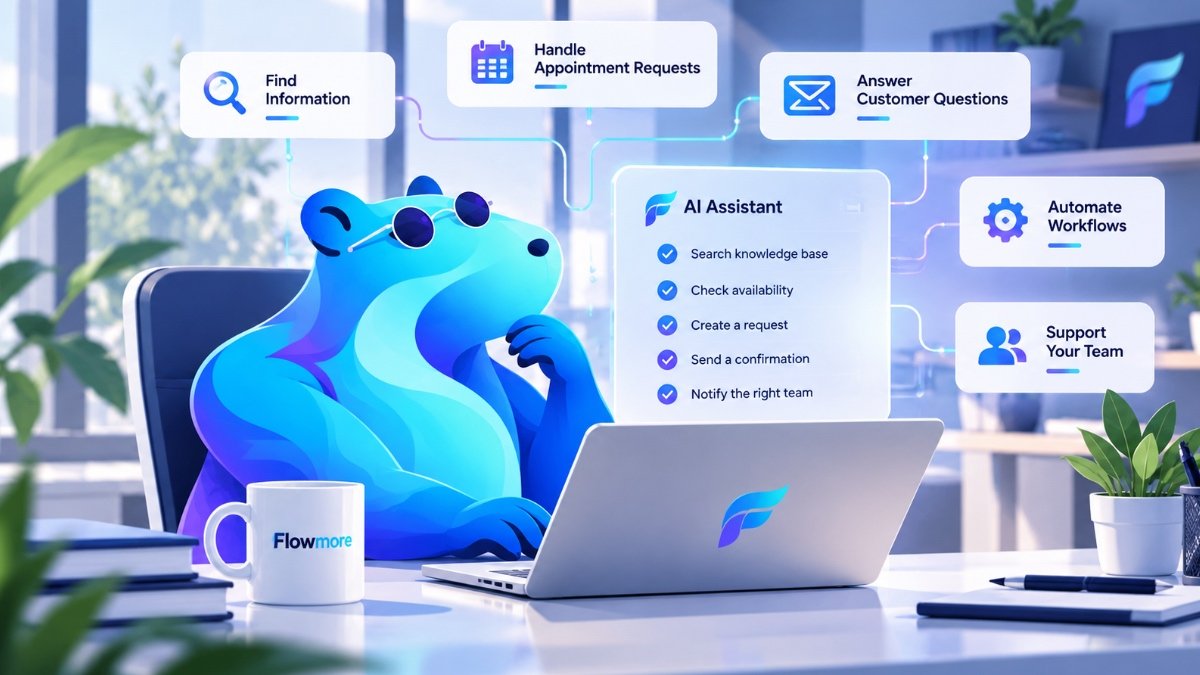
Helpful Answers.
Without the Waiting.
Your customers have questions. Your team has a hundred other things to do. Flowmore builds AI-powered assistants that help handle routine inquiries, find useful information and keep everyday conversations moving, with people involved when it matters.
Think of an assistant that knows where to find the answer.
A customer asks about your services at 9 p.m. An employee needs to find the latest procedure. Someone wants to book a consultation but isn’t sure where to start.
These are everyday situations where an AI assistant may be useful. Instead of making people search through pages, documents or email threads, an assistant can help them find relevant information and take an appropriate next step.
An AI agent can go further than answering questions. Depending on the system and permissions, it may be configured to carry out specific actions, such as creating a request, updating a record or initiating a workflow.
The important part is deciding what the assistant should do, what information it can access and when a person needs to take over.
AI assistants built around how your business actually works.
Different businesses need different kinds of help. We design assistants around specific tasks, available information and realistic expectations.
Website AI Chat Assistants
Help website visitors find answers to common questions about services, policies, processes and next steps.
Inquiry & Lead Qualification
Collect useful details from potential customers and route inquiries to the right team or follow-up process.
Employee Knowledge Assistants
Help authorized employees find information in approved internal guides, documents and resources.
Scheduling & Request Assistants
Guide customers through appointment requests and connect with supported scheduling tools where appropriate.
AI Voice Receptionists
Explore voice-based assistants that can answer routine calls, collect information and transfer conversations when human assistance is needed.
AI Agents & Workflow Actions
Connect approved assistant actions with forms, databases, CRM systems and other supported business tools.
Where an AI assistant can make a difference.
These are illustrative examples of what a properly configured assistant could help with.
The inquiry that arrives after closing
A potential customer visits your website in the evening. An assistant explains the available services, collects the details of the request and passes it to your team for follow-up.
The same questions every Monday
Staff repeatedly answer questions about required documents, office procedures and next steps. An assistant helps visitors find approved information without searching through multiple pages.
The policy nobody can find
An employee needs the current procedure for handling a request. An internal assistant retrieves relevant guidance from an approved knowledge source, subject to access permissions.
The request that needs a real person
A customer has a question the assistant cannot answer reliably. Instead of guessing, it directs the conversation to a staff member or creates a follow-up request.
An assistant should know its limits.
A useful AI assistant isn’t one that tries to answer absolutely everything. It needs reliable information, clear boundaries and a sensible way to involve your team when necessary.
Approved Information
We define which sources the assistant should use and review how that information is maintained.
Human Handoffs
We plan what happens when a request is sensitive, uncertain or needs an employee’s judgment.
Permissions & Privacy
We consider data access, user permissions, privacy requirements and appropriate limits on actions.
Start with a useful task. Build from there.
We don’t recommend launching an assistant that tries to run your entire business on day one.
Find the Right Use Case
We identify the questions or tasks that would genuinely benefit from an assistant.
Organize the Information
We review the relevant content, connected tools, permissions and expected responses.
Configure & Test
We set up the assistant, test realistic conversations and refine the experience.
Review Performance
We look for unanswered questions, confusing interactions and opportunities to improve.
Questions about AI agents and business assistants.
What’s the difference between an AI chatbot and an AI agent?
An AI chatbot generally focuses on conversations and answering questions. An AI agent may also use tools to perform specific actions, such as creating a request or initiating a workflow, subject to configured permissions.
Can an AI assistant answer questions about my business?
Yes, when it is configured with suitable information and tested for the intended questions. Responses still need appropriate safeguards because AI systems can make mistakes.
Can an AI assistant book appointments?
Depending on the scheduling software and available integrations, an assistant may help collect booking details, submit requests or work with supported appointment systems. Confirmed bookings require a reliable connection to availability.
Will an AI assistant replace my employees?
Our focus is on reducing repetitive tasks and helping employees handle routine inquiries more efficiently. Human judgment remains important for complex, sensitive and unusual situations.
How much does a business AI assistant cost?
Pricing depends on the assistant’s capabilities, information sources, integrations, expected usage and ongoing support requirements. We review the intended use before recommending a solution.
Does Flowmore provide AI agent services outside Toronto?
Yes. Flowmore is based in Toronto and works with businesses across the GTA, Ontario and Canada. Many AI assistant projects can be developed and supported remotely.
What questions does your team answer all day?
Tell us about the inquiries, repetitive conversations or information requests taking up your time. We’ll help you explore whether an AI assistant could make those interactions easier to manage.
Let’s Talk About Your Business →